





















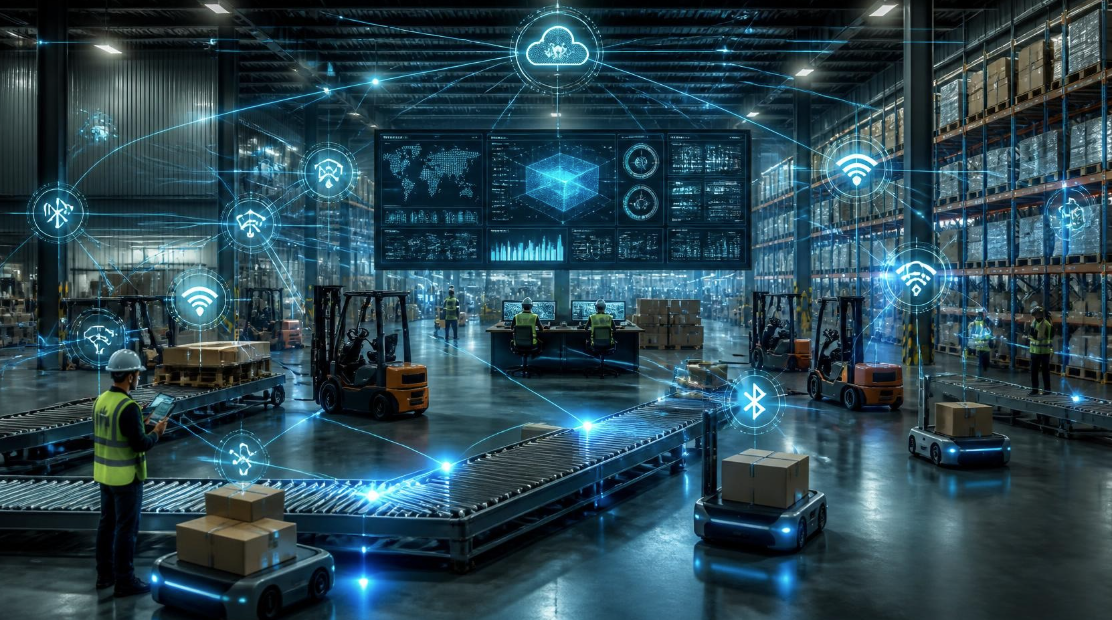
The technology floor is rising fast. The monitoring ceiling is lagging behind.
The networking infrastructure supporting modern warehouses, distribution centers, and manufacturing facilities has never been more capable. Wi-Fi 7 is delivering multi-gigabit throughput with dramatically lower latency. Private 5G networks are enabling reliable connectivity for AGVs and mobile equipment in environments where Wi-Fi has struggled. BLE sensors built into access points for years are finally being activated to provide asset location and environmental monitoring. AI inference is moving to the edge, running on devices and local servers rather than the cloud.
Each of these developments is genuinely valuable. Each one also adds complexity, interdependencies, and new failure modes to environments that are already difficult to troubleshoot. And in most facilities, the visibility infrastructure hasn’t kept pace with the technology it’s supposed to monitor.
Wi-Fi 7: faster and more complex
Wi-Fi 7 introduces 6 GHz operation, multi-link operation, and significantly higher throughput than its predecessors. For high-density device environments — where hundreds of handheld scanners, AGVs, and mobile computers are competing for bandwidth — the capacity improvements are meaningful.
The complexity it adds is also meaningful. 6 GHz doesn’t penetrate walls and obstacles the way 2.4 GHz does, requiring more careful AP placement and higher AP density. Multi-link operation changes how devices roam and connect. And the interaction between Wi-Fi 7 APs and the existing device fleet — most of which was built for Wi-Fi 5 or Wi-Fi 6 — can produce unexpected compatibility issues that don’t surface until you’re running production loads.
Every network upgrade creates a temporary window of instability. In an environment without continuous baseline monitoring, that instability is invisible until it causes an incident.
Private 5G and CBRS: reliable, but not self-managing
Private 5G networks using the CBRS spectrum are enabling use cases that Wi-Fi has struggled to support reliably: wide-area coverage for outdoor yards and multi-building campuses, deterministic performance for latency-sensitive AGV coordination, and connectivity for high-speed equipment that can’t tolerate the variability inherent in shared wireless environments.
Private 5G is also a fundamentally different technology stack than Wi-Fi, requiring different expertise, different monitoring tools, and different troubleshooting approaches. Organizations deploying private 5G alongside existing Wi-Fi infrastructure are managing two parallel wireless systems with different failure modes, different update cycles, and often different teams responsible for each.
The interdependency risk is real: an AGV that uses private 5G for movement coordination but Wi-Fi for WMS communication is dependent on both networks simultaneously. A problem on either side looks like a device problem.
BLE: years of untapped potential, now being activated
Bluetooth Low Energy capability has been built into enterprise access points for years. Most of it has been sitting dormant. Organizations are now beginning to activate it — for asset location tracking, environmental sensing, forklift proximity detection, and a range of other applications that benefit from low-power, short-range sensing.
BLE adds another data stream to the environment — one that flows through the same AP infrastructure as Wi-Fi but behaves differently, has different latency characteristics, and interacts with the wireless environment in ways that aren’t always obvious. Activating BLE on a dense AP deployment without understanding those interactions can introduce interference and performance degradation that, again, looks like a wireless problem rather than a configuration problem.
AI at the edge: the data quality problem becomes critical
Edge AI — running inference models on devices and local servers rather than the cloud — is enabling real-time decision-making in environments where cloud latency isn’t acceptable: visual inspection on a conveyor line, anomaly detection on an AGV, real-time barcode reading and package identification.
Edge AI requires clean, continuous, low-latency data. The models running at the edge are only as good as the data flowing into them. A network that’s performing at 95% of its baseline — marginally degraded, not broken — can produce data quality issues that cause AI models to behave unpredictably in ways that are very difficult to diagnose.
This is where the monitoring gap is most consequential. If you’re running AI at the edge and your underlying data pipeline has subtle quality issues, your AI output will reflect those issues — and unless you’re monitoring both the network performance and the AI output simultaneously, the connection between them won’t be obvious.
The new blind spots
Across all of these technology shifts, the new blind spots share a common structure: they live in the interactions between technologies, not within any single one. The Wi-Fi 7 AP that’s performing correctly by its own metrics but creating interference for BLE. The private 5G network that’s working perfectly but whose boundary with the Wi-Fi network creates a roaming dead zone for hybrid devices. The edge AI model that’s producing slightly degraded output because of a network latency issue three hops upstream.
None of these shows up in a single-vendor monitoring portal. All of them are visible if you’re monitoring across all layers simultaneously.
What this means for your monitoring strategy
The practical implication is straightforward: your visibility infrastructure needs to keep pace with your technology infrastructure. Adding Wi-Fi 7 without updating your monitoring approach means trading known blind spots for new ones. Activating BLE without understanding its interaction with your Wi-Fi environment means adding a new data stream without the ability to diagnose it when it causes issues.
AbeTech’s approach to this challenge starts with understanding the full technology stack — not just the wireless layer, but every device, application, and communication pathway that depends on it. The Technology Experience Assessment maps that stack, identifies the monitoring gaps, and builds a roadmap that keeps your visibility infrastructure ahead of your technology deployments rather than scrambling to catch up.
How prepared is your warehouse for Wi-Fi 7, Private 5G, BLE tracking, and Edge AI? AbeTech's Technology Experience Assessment identifies infrastructure, visibility, and monitoring gaps before they impact productivity and uptime.
Assess Your Technology Readiness Talk to our AbeTech Experts Today.