






















AbeTech Editorial • RFID & Healthcare Operations • 6 min read
In medical device manufacturing and healthcare-adjacent operations, inventory accuracy isn’t just an efficiency metric. It underpins traceability, compliance readiness, and the confidence that a device or component is where the record says it is.
Yet in many of these environments, inventory tracking still depends on manual counts, spreadsheets, and barcode-based workflows completed on a cycle schedule. These methods feel familiar — and for years, they were the standard. But they create a fundamental problem: accuracy depends on timing, not truth.
What the record shows is accurate at the moment of the last count. Everything that happens between counts — every movement, every handoff, every discrepancy — is invisible until the next cycle. In a regulated environment, that gap is not just an operational inconvenience. It’s a compliance and audit risk.
THE CORE PROBLEM
Inventory accuracy that depends on timing is not really accuracy
“The issue isn’t the time spent counting. It’s everything that happens between counts that no one can see.”
— A common pattern in medical device and healthcare inventory operations
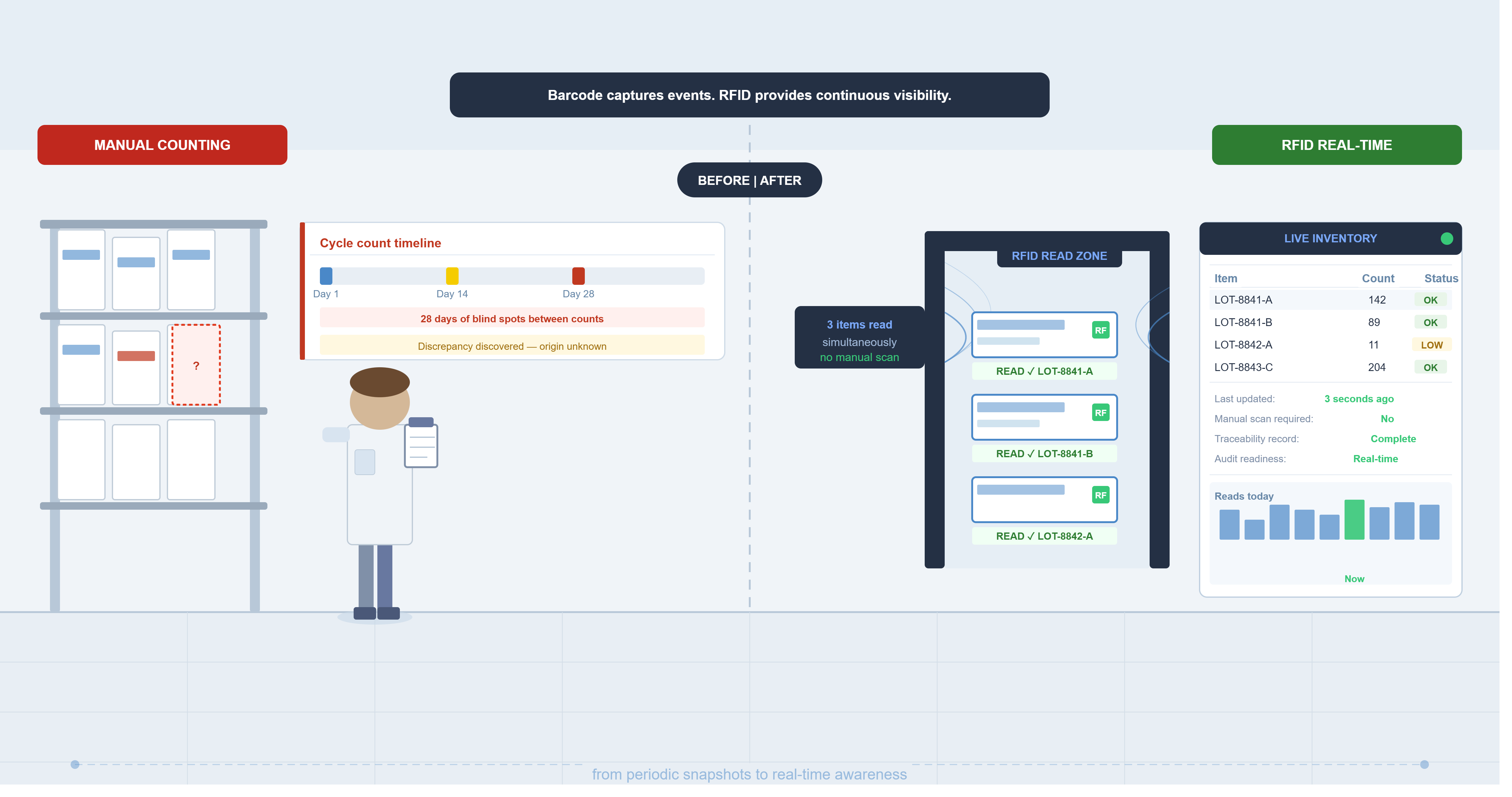
Manual cycle counting captures a snapshot. The moment the count is complete, that snapshot begins to age. Items move through production, validation, kitting, staging, and shipping — and none of those movements update the record unless someone actively scans them.
The result is a system where the inventory record and physical reality drift apart continuously, then get reconciled periodically. In a standard commercial warehouse, that drift may be acceptable. In a regulated environment where lot traceability, device history records, and audit readiness are requirements, it introduces risk that scales with operational complexity.
The discrepancy discovered during a cycle count — the item that’s recorded as present but cannot be located — is not the problem. It’s the symptom. The problem is that the visibility gap between the last count and now makes the origin of that discrepancy impossible to determine with confidence.
WHY BARCODE ISN'T ENOUGH
Barcode systems capture events. They don’t provide continuous visibility.
Barcode scanning is effective — when the scan happens. That’s the structural limitation. A barcode system knows what has been scanned. It has no knowledge of what has moved, been transferred, misplaced, or consumed without a scan occurring.
In environments where inventory moves frequently, multiple handoffs occur between teams, and human error cannot be eliminated by procedure alone, that limitation matters. Missed scans accumulate. The record drifts. And by the time an audit or a quality investigation requires a precise account of where a specific lot or unit has been, the barcode record has gaps that cannot be reconstructed.
This isn’t a criticism of barcode technology — it’s a description of what barcode is and is not designed to do. Barcode is a transaction-capture tool. Real-time inventory visibility requires something different.
WHAT RFID CHANGES
Continuous visibility without manual intervention at every step
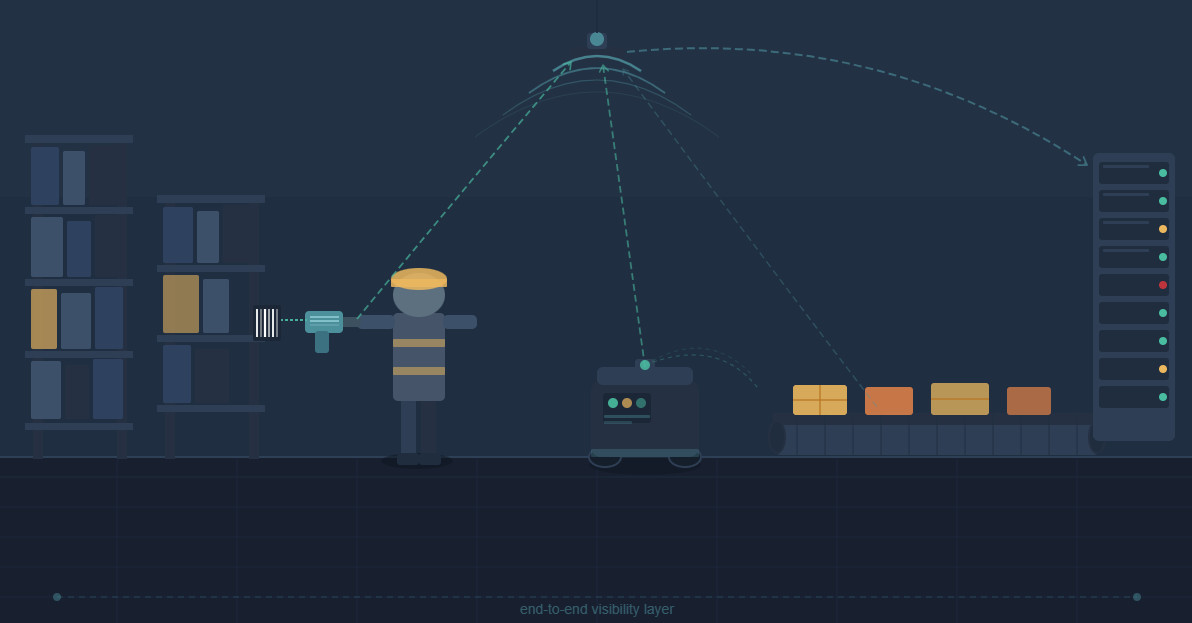
RFID replaces the scan-to-track model with an always-on model. RFID-tagged items are read automatically as they pass through read zones — dock doors, storage areas, production stations, staging areas — without requiring a worker to point a scanner at each item individually.
The practical differences are significant:
|
Manual / barcode ✗ Counted in cycles — days or weeks between updates ✗ One item scanned at a time, requires line of sight ✗ Visibility depends on worker compliance at every step ✗ Discrepancies discovered too late to trace origin ✗ Audit readiness requires manual reconciliation effort ✗ Reactive — problems surface at count time |
RFID ✓ Continuous visibility — updated in real time as items move ✓ Multiple items read simultaneously, no line of sight required ✓ Visibility is automatic — not dependent on worker behavior ✓ Movement recorded at time of occurrence, full trace available ✓ Audit record is always current — no reconciliation required ✓ Proactive — anomalies surface as they happen |
The most important shift is not speed or labor efficiency — it’s the nature of the data itself. RFID moves inventory data from periodic snapshots to continuous awareness. What was true three days ago is still true now, because every movement since then has been recorded.
WHY IT MATTERS IN REGULATED ENVIRONMENTS
Traceability, compliance readiness, and audit confidence
Medical device organizations operate under requirements that make inventory visibility a compliance matter, not just an operational preference. Lot traceability, device history records, and the ability to reconstruct the movement of a specific component through the supply chain are not optional — they are documented requirements with audit implications.
Manual and barcode-based systems can satisfy these requirements — but they do so reactively. When a trace is required, someone pulls records, reconciles counts, and attempts to reconstruct a movement history from a series of point-in-time snapshots. The process is labor-intensive and its completeness depends entirely on whether every scan along the way was actually performed.
RFID satisfies these requirements continuously. The movement record is created at the time of movement, not reconstructed afterward. When a lot trace is required — for a quality investigation, a customer request, or a regulatory audit — the record is already complete.
AbeTech works with medical device and healthcare organizations to identify where RFID delivers the highest compliance and operational value. In most cases, the starting point is not a full-facility deployment — it’s a targeted assessment that identifies the specific visibility gaps creating the most risk, and addresses those first.
WHAT A DEPLOYMENT LOOKS LIKE
Targeted impact without disrupting entire operations
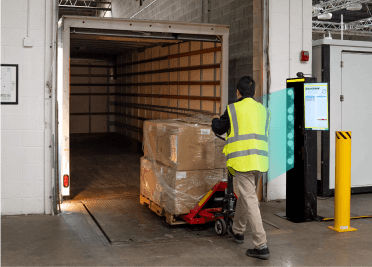
One of the most common misconceptions about RFID is that deploying it requires replacing everything at once. It doesn’t. RFID deployments in medical device and healthcare environments typically begin with the areas of highest operational and compliance risk — finished goods staging, component kitting, dock door verification, or cold chain monitoring — and expand from there.
|
Finished goods and staging areas RFID readers positioned at staging and outbound areas create an automatic record of what leaves and when. Items no longer need to be individually scanned by operators — the read zone captures every tagged item passing through, simultaneously, without a manual step. |
|
Component and raw material storage RFID-tagged components tracked through storage mean that when a lot number is pulled for a quality investigation, the system can show every location that lot visited, every handoff, and every time it entered or left a read zone. No manual reconstruction required. |
|
In-process and WIP visibility Work-in-process tracking is one of the hardest problems to solve with barcode — because items move frequently through multiple handoffs, and not every handoff gets scanned. RFID provides continuous WIP visibility without adding a scan step at every transfer point. |
|
Audit and compliance reporting Because the RFID system records movement continuously, compliance reports — lot traces, location histories, time-in-zone records — are generated from live data rather than assembled from manual counts and scan logs. Audit readiness becomes a continuous state rather than a periodic project. |
WHERE ABETECH FITS
Assessment first, deployment second
AbeTech is a trusted systems integrator with deployments across hundreds of manufacturing, warehousing, and distribution facilities, including medical device and healthcare-adjacent operations. Our approach to RFID in regulated environments starts with understanding the specific visibility gaps and compliance requirements driving the need, not with a predetermined system configuration.
That means a healthcare RFID assessment — not a sales pitch. We identify where inventory accuracy is most at risk, where traceability gaps create the most audit exposure, and where RFID can deliver the fastest and most defensible return. From there, we design and deploy a system that fits the environment, integrates with existing ERP or inventory management platforms, and produces the kind of reliable, continuous data that regulated operations require.
Manual counting is reaching its limit in environments where compliance requirements are tightening and operational complexity is growing. RFID is not a future technology for medical device operations — it is a practical, deployable solution that organizations in this space are using today to close visibility gaps that manual methods cannot address.
TAKEAWAY
From periodic snapshots to real-time awareness
The question is not whether manual inventory methods have limitations. They do, and in most regulated operations, those limitations are already visible — in the discrepancies discovered at count time, the traces that cannot be fully reconstructed, and the audit preparation that takes longer than it should.
The question is whether those limitations are acceptable given the compliance environment and operational complexity of the business. For many medical device organizations, the answer is increasingly no.
RFID closes the gap. AbeTech helps you identify where the gap is largest and address it in a way that is practical, compliant, and built to last.
Ready to identify your visibility gaps?