























Your devices are supposed to make work easier. For most enterprise IT teams, they've become the work.
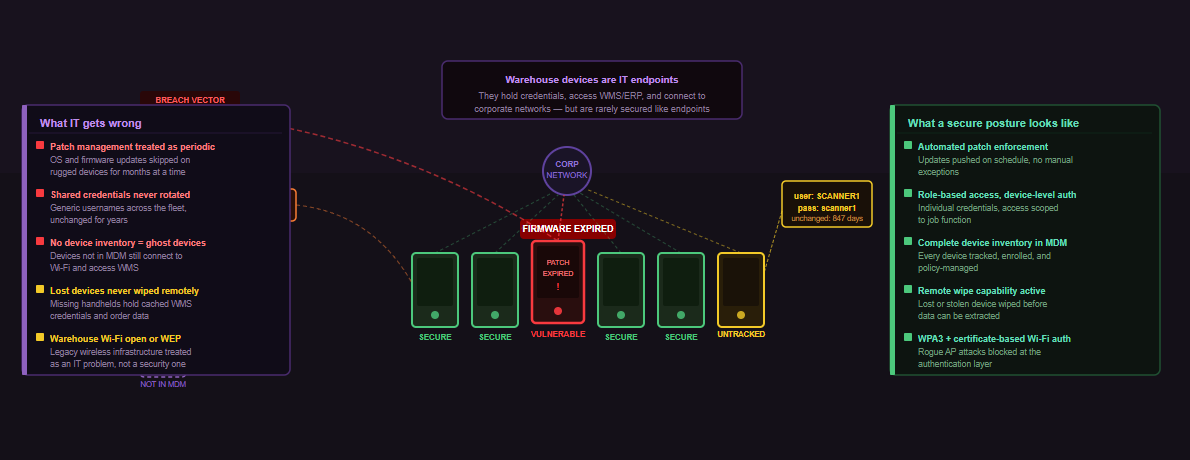
Aging handhelds that need constant babysitting. Scanners running unsupported firmware. Mobile apps that behave differently depending on who deployed them and when. A support queue that never gets shorter. And somewhere in the back of your mind, the nagging awareness that you don't have a complete picture of what's actually out there — or how vulnerable it is.
This is the reality for most organizations managing large device fleets today. And it's not a technology problem. It's a visibility and control problem. The good news: it's solvable.
The hidden cost of a fragmented device environment
Most IT leaders can tell you how many devices they own. Far fewer can tell you, in real time, which ones are underperforming, which are out of compliance, which are sitting idle at a location they shouldn't be, or which are one firmware version away from a security exposure.
That gap has a cost — and it shows up in ways that aren't always easy to trace back to device management:
- Support tickets that could have been prevented. When devices aren't proactively monitored, small issues become user-reported incidents. Those incidents create tickets, tickets create backlogs, and backlogs create frustrated frontline workers and overloaded IT staff.
- Unplanned downtime on the floor. In warehouse and manufacturing environments, a device failure at the wrong moment doesn't just inconvenience a worker — it stops a process. The cost per hour of unplanned downtime far exceeds the cost of preventing it.
- Security exposure at the edge. Every unmanaged or poorly managed endpoint is a potential entry point. As device fleets grow across multiple sites and generations of hardware, the attack surface grows with them.
- Capital wasted on the wrong refresh cycles. Without data on actual device performance and utilization, organizations either hold onto hardware too long or replace it too early — neither of which is optimal.
The organizations that have solved this problem share one thing in common: they stopped managing devices reactively and built a proactive, lifecycle-based approach instead.
What lifecycle management actually looks like in practice
The shift from reactive to proactive device management doesn't happen by adding more tools to an already crowded stack. It happens by establishing a structured approach across every phase of a device's life — from the moment it's provisioned to the moment it's retired.
Deployment should be fast and consistent. New devices should arrive preconfigured, preloaded with the right apps and security policies, and ready to hand to a frontline worker at any location without requiring on-site IT involvement. Every device, every site, every time.
Ongoing management should be centralized. A single dashboard showing fleet health, compliance status, real-time usage, and performance metrics across every device and location — not a patchwork of vendor portals and spreadsheets.
Support should be proactive, not reactive. The best device management programs catch issues before users report them: anomalous battery drain, connectivity degradation, compliance drift. When incidents do occur, streamlined RMA processes and fast response options mean minutes of disruption instead of hours.
Security should be built in, not bolted on. Encryption standards, lockdown protocols, and remote wipe capabilities aren't optional features — they're baseline requirements for any enterprise operating at scale.
End-of-life planning should be deliberate. Knowing when to refresh aging hardware, how to repurpose equipment across locations, and how to retire devices without creating security or compliance gaps is as important as knowing what to buy next.

Why most device management efforts stall
The obstacles aren't usually technical. They're organizational.
IT and operations often have different priorities. IT cares about security, compliance, and supportability. Operations cares about uptime, user experience, and not having their workflows disrupted by a device refresh. When those priorities aren't aligned from the start, rollouts stall, adoption suffers, and the benefits of a well-managed fleet never fully materialize.
The other common failure point: trying to build this capability entirely in-house. For organizations managing thousands of endpoints across multiple sites, the internal bandwidth required to do device lifecycle management well is substantial — and often not available. The result is a program that works fine in controlled conditions and falls apart under the pressure of peak season, rapid growth, or a security incident.
How AbeTech approaches it differently with Abe360
Abe360 is AbeTech's enterprise device lifecycle management platform — built not just as software, but as a fully supported program that combines tooling, process, and people.
It starts before a single device is deployed. AbeTech's team conducts a structured endpoint environment assessment: mapping your current device landscape, identifying support gaps, documenting network security requirements, and building a forward-looking roadmap tailored to your operation. The goal is to eliminate surprises during rollout — and to align IT and operations stakeholders before the project starts, not after friction surfaces.
From there, Abe360 manages the full lifecycle: rapid deployment of preconfigured devices, centralized visibility across your entire fleet, proactive help desk support, enterprise-grade security controls, and a deliberate end-of-life strategy that maximizes return on every hardware investment.
The results speak for themselves. Organizations using Abe360 see up to a 40% reduction in support tickets through proactive monitoring, 3x faster incident response with centralized management, and an IT team that's finally focused on strategy instead of firefighting.
Whether you're managing 500 devices or 50,000, the approach scales.
Ready to see what's possible for your fleet?
If your IT team is spending more time reacting to device problems than preventing them, it's time for a different approach.
Start with an Endpoint Environment Assessment — a conversation where AbeTech maps your current state, identifies your biggest gaps, and shows you what a structured lifecycle management program would look like for your specific environment.
Reach out to an AbeTech expert about your device management challenges today! abetech.com